Why I Keep Two Sizes of Color Shells on My Station
After thirty years behind the chair, I’ve learned that the difference between a good highlight and a great one usually comes down to one thing: control. Not just the color you mix — though that matters — but how precisely you can place it, watch it, and pull it at exactly the right moment. That’s the real reason I keep two sizes of Color Shells within arm’s reach for every single color service.
It took me a minute to change how I’d worked for decades, but once I started matching the size of the shell to the section in front of me, my work got cleaner and faster at the same time. Here’s how I think about it.
The standard shell does the heavy lifting
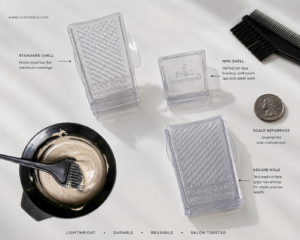
For most of a highlighting service, the standard Color Shell is my workhorse. It’s sized to hold a generous, even ribbon of hair, which means I can build dimension quickly without stopping to re-section every couple of minutes. When a client wants all-over brightness or a full head of balayage-style pieces, the larger shell lets me lay in wide, clean panels and keep my rhythm going. More coverage per placement means fewer placements — and on a busy Saturday, that time adds up fast.
The length and width of the standard shell suit the majority of highlights I do in a day. It’s the size I default to, and for good reason: it’s built for efficiency on the broad zones where you want consistent, even saturation.
The mini shell is for the work that makes or breaks a look
Then there’s the detail work, and that’s where the mini shell earns its place on the station. Face-framing pieces, root retouches, and those awkward narrow spots near the hairline or the part — the smaller, slightly narrower shell fits where the standard one simply can’t. I reach for it constantly on clients with shorter hair, where there’s just less real estate to work with. And every colorist knows the feeling of ending up with a tight, narrow section that your tool is just a hair too big for. That’s exactly the moment the mini shell solves.
The first time you retouch a delicate money-piece section with a mini shell instead of wrestling a too-large tool into place, you’ll wonder how you ever managed without it. Having both sizes on hand isn’t about owning more gear — it’s about matching the tool to the section instead of forcing one tool to do every job.
See-through is the feature I didn’t know I needed
Because Color Shells are clear, I can actually watch the color develop inside the shell. No peeking, no guessing, no cracking foils open and hoping I timed it right. I can see the lift happening in real time and pull the section at the exact moment it hits the tone I want.
For anyone who’s ever over-processed a fragile face-framing piece because they couldn’t see what was happening under a foil, that visibility is a true game-changer. It turns timing from a gamble into a decision — and that’s especially valuable on the bright, close-to-the-scalp work where there’s no room for error.
Build your sectioning around the tool
Once you’re working with two sizes, your whole approach to sectioning gets smarter. I map the head before I start: standard shells for the broad zones through the back and sides, mini shells reserved for the hairline, the part, and any retouch work up front. The tool tells you where it belongs.
The textured grip on the shell holds the hair steady and keeps product right up against the strand, so close-to-the-scalp placement stays clean instead of slipping. It’s a small shift in how you set up your station, but it changes how the whole service flows. You stop improvising and start working with real intention.
The bottom line
Great color isn’t about having the most product on your trolley. It’s about control — and two sizes of a tool that grips well, sits close to the scalp, and lets you see the development gives you exactly that. If you’ve been making do with a one-size-fits-everything approach, give yourself the range. Your tighter sections, your shorter-haired clients, and your timing will all thank you.
You can find both the standard and mini Color Shells over at our shop.
Colorists — do you switch sizes depending on the service, or is there one shell you simply can’t work without? I’d love to hear how you’re using them.