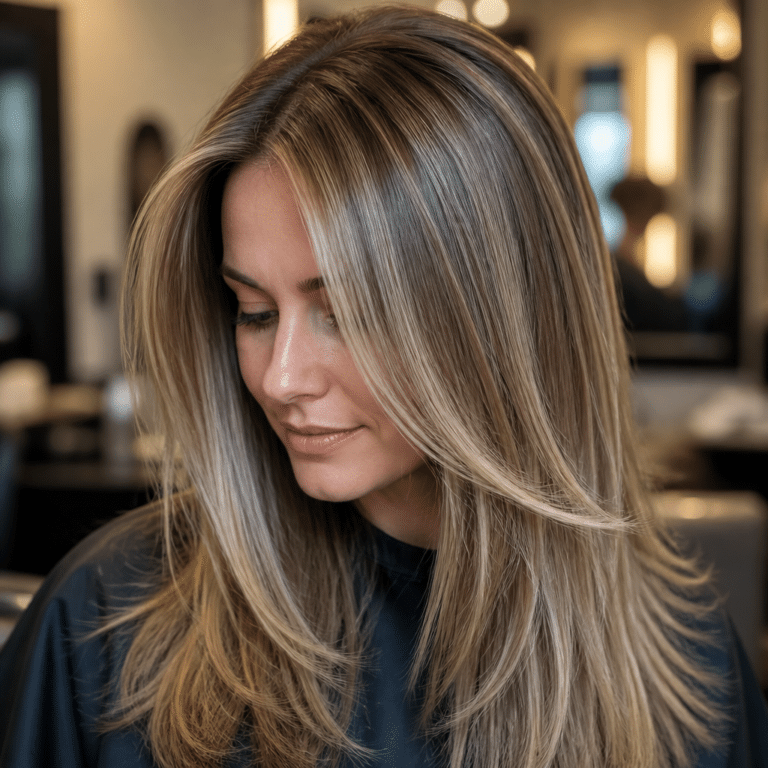
I ran a salon floor for a long time, and if there’s one thing I watched happen at the mirror at the end of every single color service, it’s this: the client reaches up and checks her part. Not the back, not the ends — the part. That narrow line down the top of the head is the first place her eyes go, and it tells her, in about two seconds, whether she trusts the work. After decades behind the chair, I started treating the part like the headline of the whole service. Get it right and everything else reads as polished. Miss it, and the most beautiful balayage in the world suddenly looks unfinished.
Highlight Across the Part, Not Along It
Here’s the placement habit that changed my results: I set my highlights perpendicular to the part, crossing it like a plus sign — a little “+” running over that line instead of beside it. When you place color across the part, the lightened pieces fall on both sides and the part disappears into dimension. When you only highlight alongside it, you leave a stripe of base color sitting right where she’s looking hardest, and it reads as a gap.
I carry that same “+” pattern straight back over the crown. Pay attention to the area around the whirl — that spot where the hair naturally separates and swirls. Clients mistake it for a thinning or “bald” spot all the time, because that’s exactly where scalp shows through when there’s no light placed there. Even on a partial highlight, I work that crown section in. It costs me a few extra pieces and it saves the whole consultation conversation at the end.
The Money Piece Lives or Dies at the Scalp
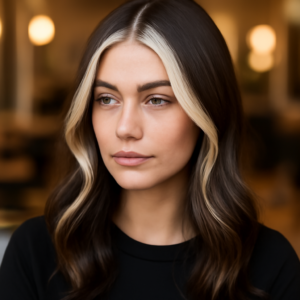
The look my clients ask for more than any other right now is the face-frame — a bright strip framing the face, often bleached and toned almost white. The industry forecasts back this up: face-framing money pieces are the most-requested salon color of 2026, and the mood has shifted toward soft, “expensive-looking” brightness over chunky contrast. The thing nobody tells you about that piece is that it’s all about how close to the scalp you can get cleanly. A money piece that starts half an inch down looks grown-out the day you do it.
This is where my tool actually matters. I switched my floor to ColorShells — reusable, transparent highlighting shells — because the snap-on design grips the hair right up at the root without slipping. For a face-frame, that grip is everything: I can place lightener tight to the scalp and trust it to stay put while I work the other side. And because the shell is clear, I’m not peeling anything open to peek. On a retouch especially, when I’m matching a near-white piece she’s worn for months, being able to watch the lift develop in real time is how I hit the exact tone every time instead of guessing and hoping.
Why Real-Time Visibility Beats the Clock
Foil makes you commit blind. You fold it, you set a timer, and you find out if you were right when you open it — and by then it’s a correction, not a placement. The bright face-frame is the least forgiving piece on the whole head, because she sees it head-on in every mirror, every day. Watching it process through a transparent shell turns timing from a gamble into a decision. You pull it when it’s right, not when the timer says so. That’s also the reason a clear shell pairs so naturally with the high-shine, glossed finishes clients keep asking for: precise lift is what protects the hair enough to take a glossy tone without looking fried.
Small Placement Habits, Big Trust
None of this is complicated. Cross the part with a “+”, carry it over the crown and the whirl, get the money piece tight to the scalp, and let yourself see the color develop instead of guessing. These are the small, repeatable habits that make a client run her fingers through her part, smile, and book the next appointment before she leaves. The product behind the chair should make those habits easier, not fight you for them.
If you want to feel the difference in grip and real-time visibility on your own clients, you can pick up a kit at colorshells.com/shop and try it on your next face-frame retouch.
Where do your clients look first when you spin the chair around — and how do you place your highlights to win that first glance? I’d love to hear how you handle the part and the money piece in the comments.